Scorchers
Vainqueur the DragonThe Scorchers are the book’s clearest example of war surviving its official end. They began as soldiers and mercenaries serving Gardemagne during the Century War, but when the conflict ended, the habits, permissions, and profits of organized violence did not disappear. Instead, former combatants became roving bandits and mercenary bands, ravaging the countryside and forcing the postwar kingdom to confront a disorder created by its own military past.
Origins and Organization
The Scorchers emerged from the demobilization of Gardemagne’s wartime forces. Their leaders explain that, during the Century War, the king granted adventurers and mercenaries writs allowing them to raid enemy towns in his name. Massacring civilians and burning villages had therefore been treated as respectable service when directed against an enemy. After peace returned, the same conduct became politically unacceptable, while the men who had practiced it were told to retire, farm, or undertake the more dangerous work of monster hunting.
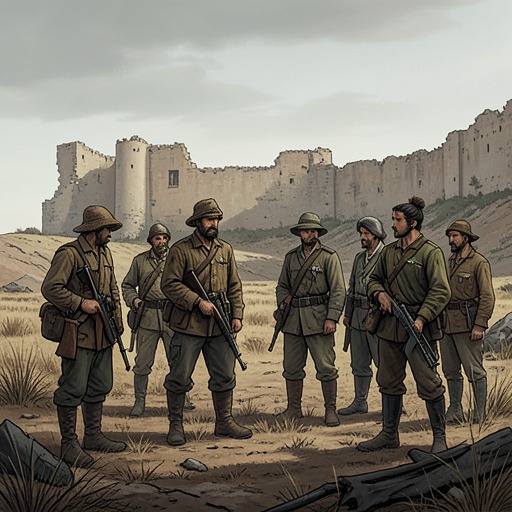
This transition left the Scorchers with military experience but without a legitimate place in the new order. Their bands retained the structure of armed companies, yet their targets became helpless peasantry and settlements rather than enemy towns. The organization consequently occupies an unstable space between outlaw gang, private army, and displaced veterans’ network. Its members are not presented as random thieves: they possess commanders, warbands, battlefield knowledge, and the capacity to conduct sustained operations across the countryside.
Crimes and Leaders
The Count identifies the Scorchers as the principal threat to Gardemagne’s peace, describing them as roving bandits and mercenary bands active since the end of the Century War. Their crimes include murders, abductions, arsons, property destruction, slaughters, and other war crimes against civilians. Duchess Aelinor of Euskal responds by placing bounties on their leaders, converting the Scorchers’ violence into a series of officially sanctioned hunting contracts.
Three commanders receive particular attention. Gustave La Muraille is a former Gardemagnian army officer who deserted and now leads a warband of twenty soldiers. His wanted notice records twenty levels in Knight, four in Heavy Knight, and three in Turncoat, for a total level of twenty-seven. He is wanted for the sack of the Poustagniac village and the massacre of its eighty-seven inhabitants, with a bounty of five thousand gold coins offered for his head.
Ogron the Ogre is identified as the strongest of the three and is credited with a triple-digit body count. His bounty is ten thousand gold coins, twice Gustave’s reward. François Vilmain, a corrupt priest who reinvented himself as a demon summoner, carries a five-thousand-coin bounty. Together, the official rewards for the three leaders total twenty thousand gold coins, a sum that makes the Scorchers attractive targets even to Vainqueur Knightsbane, whose interest in justice is repeatedly filtered through calculation, treasure, and the promise of useful enemies.
Alliance with Brandon Maure
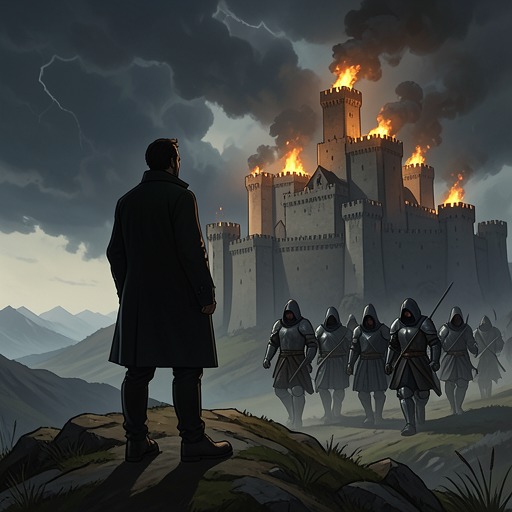
The Scorchers’ criminal activity is not merely local opportunism. François Vilmain explains that Brandon Maure of Ishfania offered the former soldiers a generous retirement payment and asylum in exchange for burning the countryside of Euskal and keeping the crusaders occupied while Maure retook his fortress of Rochefronde. The arrangement gives the Scorchers a political function: their raids are intended to exhaust defenders, obstruct mobilization, and create the conditions for a larger territorial campaign.
Haudemer is included in that strategy. Vilmain states that the destruction of Haudemer is necessary to their agreement, even though a dragon guards the city. The Scorchers first lose men when Vainqueur Knightsbane eats them, then lose more when additional troops investigate the disappearance. At the same time, the royal army begins closing in on them. Their difficulty is therefore both military and financial: Vainqueur Knightsbane threatens their manpower, Gardemagne threatens their freedom of movement, and failure to destroy Haudemer threatens the payment and political protection promised by Maure.
The episode exposes the Scorchers’ dependence on a larger power. Their violence appears autonomous when viewed from the villages they attack, but their campaign is also subcontracted warfare. Brandon Maure supplies money and sanctuary; the Scorchers supply terror, destruction, and diversion. Their old occupation of sanctioned raiding has been repurposed for a new patron, showing how demobilized violence can be absorbed into another state’s ambitions rather than ended by a peace treaty.
Conflict with Haudemer and the Wider War
The Scorchers’ pressure on Haudemer is linked to the disappearance of Henry Bright. After Henry’s home is ransacked and his research stolen, François Vilmain sends a blood-signed message offering to discuss the release of their “common friend Henry” and an offering of gold in exchange for the use of Haudemer’s ships. The demand reveals that the Scorchers are willing to combine hostage-taking, negotiation, and maritime coercion. Their objective is not simply to loot the city; they want access to its logistical resources for the larger campaign.
Their methods also place them in direct contrast with the institutional forces forming around Vainqueur Knightsbane. The Scorchers rely on predation and hired violence, while Haudemer and its allies increasingly rely on organized defense, adventurer structures, and alliances with monsters. In later conflicts, the military world has expanded beyond conventional human armies: V&V Adventurer Company members defend Murmurin, citizens construct barricades, Allison and Rolo raise a barrier of thorns and blackberries, and Vainqueur Knightsbane confronts an enemy flying fortress in the sky. The Scorchers belong to the earlier, rougher stage of this transformation, when a warband can still terrorize a countryside through mobility and impunity.
Narrative and Historical Significance
The Scorchers embody the book’s recurring refusal to separate respectable institutions from monstrous or criminal violence. Their leaders were once authorized by a king to raid and destroy enemy settlements; afterward, the same acts are condemned when performed outside a settled political framework. The difference between soldier and bandit is therefore shown to depend partly on who issues the writ, who benefits from the violence, and whether the war has been declared finished.
Their story also gives the wider conflict a social aftermath. Gardemagne’s peace is threatened not by an abstract enemy but by armed men left over from the Century War, while villages bear the cost through massacre, fire, and property loss. At the same time, the Scorchers’ partnership with Brandon Maure demonstrates how local insecurity can be manufactured into an instrument of conquest. Once Maure’s army is destroyed and Maure dies, Ishfania itself disappears as a nation and becomes a contested resource zone that other powers may try to claim. The Scorchers’ campaign thus belongs to a chain running from demobilization, to banditry, to proxy warfare, and finally to the political vacuum left by total defeat.
Their function in the narrative is consequently larger than that of ordinary villains. The Scorchers provide Vainqueur Knightsbane with bounty targets and a source of immediate danger, but they also expose the economic logic beneath heroic quests: violence becomes a contract, corpses become salvage, and even the defense of civilians is entangled with rewards and territorial claims. Against that grim continuity, the later mobilization of monsters, adventurers, and newly recognized states suggests not that war has vanished, but that the institutions controlling it have changed hands.